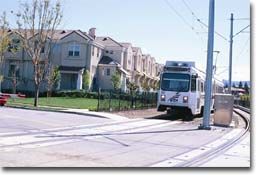
Transit-oriented development(TOD), the culmination of many concepts of sustainable development and transportation, is about choice. Transit oriented communities, where development is centered around a higher density core, can be better places to live because people have an array of travel options and less dependence on any one way of getting around.(1) "TODs mix residential, retail, office, open space, and public uses in a walkable environment, making it convenient for residents and employees to travel by transit, bicycle, foot, or car."(2)
|
"People are not simple and we should not attempt to make them so with cities and suburbs that limit their choices. I believe a diverse and inclusionary environment filled with alternative ways of getting around is inherently better than a world of private enclaves dominated by the car." Peter Calthorpe, author of The Next American Metropolis: |
|---|
TODs:
TODs achieve the need for simultaneous planning for land use and transportation. Planning TODs, even without existing transit available, allows for the possibility of adding transit later effectively and more inexpensively, an important part of sustainable transportation.
The uses that should be encouraged in TODs should be those that do not rely entirely on the auto. They should be uses that pedestrians can take advantage of and serve the basic needs of the community. "Up to 75% of all household trips are non-job related. Many of these non-commute trips can be captured within the TOD."(4)
Implementation Opportunities:
- "Designing for transit" Metropolitan Transit Development Board, San Diego, CA. July 1993, p.5.
- Calthorpe, Peter. The Next American Metropolis. p. 56
- "Designing for transit" Metropolitan Transit Development Board, San Diego, CA. July 1993, p.3
- Calthorpe, Peter. The Next American Metropolis. p. 101
- Calthorpe, Peter. The Next American Metropolis. p. 60
| Sprawl and transportation | Edge Cities |
|---|
.

