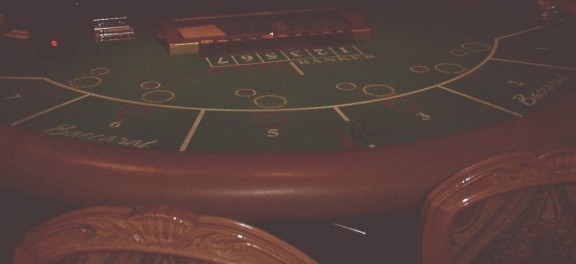
Photo by Anthony Bedogne, Paris Hotel and Casino, Las
Vegas, NV
Gaming vs. Gambling
Gaming is a term used to identify legal forms of betting; such as state lottery, horse race betting, and state sanctioned casino operations.
Gambling is a crime, to make a wager on a game of chance without the control of a licensed party. Gambling is illegal betting and can be punishable by the court of law. This includes Internet gambling.
Who controls the Casino
The state structure of the gaming industry is composed of private casino gaming, tribal class I, II, & III gaming, state lotteries, charitable gaming, and horse racing. The control varies from state to state. Several licenses need to be obtained from the state level to institute a gaming enterprise, including the legalization of gaming in that state. Fees are associated with each license and it is the responsibility of the proprietor to seek compliance. It is through regulation that a healthy gaming environment is created, the intent is to ensure proper apportionment of revenue and a safe business for the community.
∑ A manufacture/distributor license is needed from all businesses that will distribute gaming materials.
∑ A retail license is needed by the facility, which permit casino gaming on the property.
∑ An operator license is required by those who place and operate slot machines and gaming tables.
∑ A gaming managerial license is required of those individuals who have the responsibility or authority to make policy decisions.
∑ A support compliance license is needed of most casino workers including card dealers, cashiers, accounting personnel, and security personnel. Some states also require food/beverage servers and parking valets to be licensed as well.
Where does the revenue come from?
Retail casinos on private property pay gaming taxes. The local municipality can also levy property taxes on the facility, or lease the land to an investor. The gaming tax structure is set by the states' gaming authority or gaming board of commissioners.
A percentage of tax is paid based on the amount of Adjusted Gross Proceeds (AGP) a casino brings in. This is the gross revenue earned, less payment made to patrons. In other words the amount bet by gamers and lost. As the proceeds (AGP) increases so does the taxable percentage. The state may also require additional fees for each gaming device, (slot machine or table) taken out before the AGP is taxed.
Common Gaming Tax Structure Apportionment: Percentage of
Taxable AGP
q â 50% State General Fund - To implement statewide programs
q â 25% Charity organizations and historical preservation grants
q â 15% County Government
q â 10% Local Municipality
q â <1% State Tourism Organizations
Community gaming revenue based on 10% of THE TAXABLE AGP
Source: Bear, Stearns & Co. Inc.
(November 2002) - Annual
Revenue 2001 data
|
City/Region |
Annual Revenues 2001 |
Gaming Tax Based on Standard Structure of (+1
billion @ 20%) of AGP |
Local Municipal Earnings - @ 10% of Gaming Tax |
|
Las Vegas -- Strip |
$4.7 billion |
$940,000,000 |
$94,000,000 |
|
Atlantic City, NJ |
$4.3 billion |
$860,000,000 |
$86,000,000 |
|
Chicagoland (IL, IN) |
$2.2 billion |
$440,000,000 |
$44,000,000 |
|
Detroit/Windsor, Canada |
$1.4 billion |
$280,000,000 |
$28,000,000 |
|
Tunica/Coahoma, MS |
$1.2 billion |
$240,000,000 |
$24,000,000 |
|
Mississippi Gulf Coast |
$1.15 billion |
$230,000,000 |
$23,000,000 |
|
Reno/Sparks, NV |
$961.3 million |
$192,260,000 |
$19,226,000 |
|
Shreveport, LA |
$806.2 million |
$161,240,000 |
$16,124,000 |
|
Southern Indiana |
$788.1 million |
$157,620,000 |
$15,762,000 |
|
St. Louis, MO |
$766.3 million |
$153,260,000 |
$15,326,000 |
Planning for Gaming
Casino gaming needs to plan from the regional approach. Several government agencies benefit financially from the gaming business. Used as a long-term investment the casino can pay for capital improvements such as infrastructure, schools, public safety, transportation, and recreation amenities.
The most negative impact that casinos bring to the community is traffic and parking. As part of the comprehensive planning process, sectors of the community will complement the gaming industry including major arterial transit routes and highway commercial industries for the tourist. Cases when casino gaming has had a negative effect on the downtown is where it was not planned to fit into the community, and the existing mix of businesses was not enhanced to accommodate the influx of tourism.
The site location of a casino should not be nested within a downtown neighborhood; due the nature of gaming it requires access and parking so it would not be successful here. Perhaps just outside of the downtown located on arterials.
There is a trend for gaming locations to be grouped together across an area, in a way to accommodate each other and enrich the overall tourism experience. It is all part of the planning process, thus if the community prepares regionally for gaming industries the benefits of capital improvements are inevitable.
Effects of Gaming Downtown
The economics of adding gaming to a community will promote tourism and raise the tax base. The direct revenue from gaming tax should not be funneled into the general budget of the community, but used for specific revitalization projects. Local businesses benefit from the overall success of the entertainment market within the community. The gaming industry can work with businesses downtown to promote mutual commerce efforts by sponsoring a local merchant campaign or free downtown parking passes. The casino fills a specific niche that will not deter spending from the local industries.
The casino's employment opportunities go beyond card dealers and cocktail waitresses. The gaming industry is also beneficial to regional distributors. Resorts need cooks and food, the entertainment industry becomes involved, the information technology industry is used for surveillance and accounting, construction and design professionals can reap initial benefits of development. Citizens can now reinvest the local cash exchange into the community.
Should schools and residents be concerned about the "unpleasant element" a casino will bring to the community? Corruption and security are highly regulated by the state gaming commission. More protection is provided at casinos than at a stadium, a zoo, or a public park. The municipality will have new character and the resources to invest in additional safety services if needed. Las Vegas, NV the gaming capital of the world, has proven to be one of the safest large American cities.
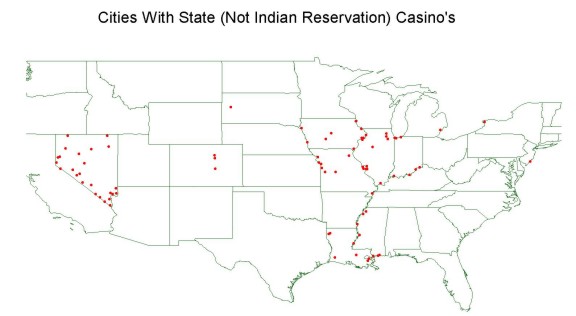
Map by Anthony Bedogne
Other Suggested Websites:
Citations:
American
Gaming Association
Colorado
Division of Gaming
Michigan
Gaming Law
Bear, Stearns & Co. Inc.
(November 2002) - Annual
Revenues 2001
"City takes casino effects, "
Wausau Daily Herald" 3 Nov. 2002
Webpage Author
Anthony Bedogne
