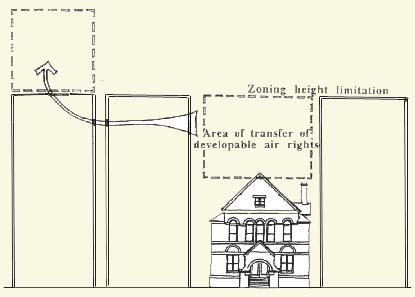
A Transfer of Development Rights (TDR) program allows owners of buildings in zoning districts where more intense develop ment is permitted to sell that development potential to owners of other sites. As shown in the diagram below, air rights are literally purchased by another owner for use on a second site.
The city of Philadelphia provides an example of a Transfer of Development Rights program. The TDR program came about when an ordinance was passed to prevent the demolition of a landmark downtown building. At the same time an old "gentlemen's agreement" was broken not to build a downtown building higher that the hat on the sculpture of William Penn on the City Hall. It was recognized that development should be encouraged while the historic character of the downtown district was preserved. The Philadelphia TDR program allowed for this, and had three goals when it was established in 1991;
More than 200 owners of historic structures were eligible to sell development rights through the TDR option. This incentive was combined with two other development programs--an enhanced tax abatement program that included historic properties, and a large revolving loan fund.
San Francisco considered the use of a TDR program as a way to encourage preservation, described in "A Preservation Strategy for Downtown San Francisco."2
The study proposed the following recommendations for the use of TDRs:
1 Donna Ann Harris, "Philadelphia's Preservation Incentive," Historic Preservation Forum, (Washington, D.C.: National Trust for Historic Preservation, September/October 1992) p. 10.
2 Prepared by John M. Sanger Associates, Inc. for the Foundation for San Francisco's Architectural Heritage.
3 Nancy C. Shanahan, "Downtown Preservation Strategies and Techniques," Preservation Law Reporter, Volume 3, No. 3 (May 1984), p. 3 PLR 2033.
| Problems in Downtowns | Preservation and Downtowns |
|---|
| Economic Benefits of Preservation |
|---|

