Easements are a potentially valuable means to both protect historic buildings and compensate their owners. Using an easement, an owner of a property with a historic facade can agree to give up the right to change the facade "in perpetuity." The current owner and all future owners are bound to the easement provisions, whatever they may include. In return, the current owner can claim as a donation for tax purposes the value of the easement.
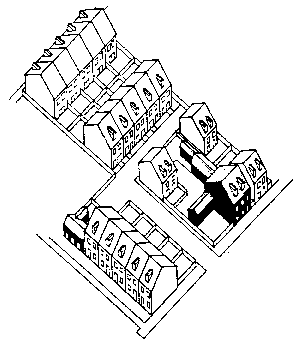
An example best describes how easements may be used for historic properties. The sketch below shows an actual property in Alexandria, Virginia,1 a community with high property values located near Washington, D.C. The property includes a significant historic house and carriage house (shown in black). The two structures and land had a total market value of $200,000. However, a developer was offering $1 million for the property, subject to approval to build 18 townhouses as shown. The owner, recognizing this much greater value, wanted to sell, but the local historic district commission would not approve such intensive development of the property. The owner felt he was being treated unfairly, and said he should be compensated by the city for the $800,000 loss of potential profit resulting solely from the historic district commission's designation. The courts, however, have consistently upheld a community's right to deny inappropriate development of historic properties, as long as owners continue to get a reasonable return on their property, even if it isn't the highest and best return.2
In this case, however, the owner was able to recoup some of that loss in potential income by claiming a property easement. An agreement in perpetuity was attached to the property title that said that the property would remain as it was, with the right to develop donated to the local commission. In return, the owner could claim a personal tax deduction for the $800,000 difference. Depending on the owner's tax bracket, this could be a large proportion of the total amount, and would serve as considerable compensation for not being able to develop.
Questions regarding the procedure immediately arise, however:
QUESTION: Who determines the value of the easement?
A well qualified appraiser who has had experience with similar appraisals should determine the fair market value of the easement.3
QUESTION: Who checks over the years to insure that the facade or other easement component remains unaltered?
A not-for-profit organization (known by tax law as a 501c3) must inspect the condition of the easement at least once a year, both to see that it has not been altered and to ensure that it is being properly maintained. The organization may be chosen from a local or statewide preservation group, a local historical society or the State Historic Preservation Office.
One can appreciate why easements are not often used for historic structures, and why their use often leads to complications. The program is good in theory, but not so good in actual practice. The Government Accounting Office conducted a conducted a study4 that found that easements were typically overvalued by appraisers, often at 200% or more of their actual value. It was in the owner's interest to have a high appraisal, and very few appraisers are experienced in evaluating easements and therefore don't have other "comparables" from which to extrapolate values. Owners also find it difficult to identify not-for-profit associations willing to oversee an easement, typically without compensation. This responsibility has great potential for problems, but little in the way of reward. Finally, owners are discouraged by the fact that easements must be given in perpetuity, which decreases the overall value of their property because some rights of ownership are denied to potential new owners.
When properly set up and administered, however, easements are a good way to maintain a property's historic integrity. They permit a community to hold onto important elements of its architectural heritage, and they benefit owners, who earn tax breaks while ensuring that the integrity of a historic building has been protected for posterity.
1 Thomas Coughlin, "Easements and Other Legal Techniques to Protect Historic Houses in Private Ownership," (Washington, D.C.: Historic House Association of America, 1981).
2 Refer to the precedent-setting Penn Central decision explained elsewhere.
3 For a reference on appraising easements, see National Trust for Historic Preservation and Land Trust Exchange. Appraising Easements: Guidelines for Valuation of Historic Preservation and Land Conservation Easements. Washington, D.C.: National Trust for Historic Preservation. 1984.
4 U.S. Government Accounting Office study on abuses of tax incentives and appraisals.
| Problems in Downtowns | Preservation and Downtowns |
|---|
| Economic Benefits of Preservation |
|---|

