Brief History of Zoning
To look at the impact zoning ordinances have had over time one must look at the original regulations and the concerns which they were meant to address. As stated in the Zoning Primer, published in 1922 by Secretary of Commerce Hoover, zoning can be compared to one's own household, "Some one has asked, 'Does your city keep its gas range in the parlor and its piano in the kitchen?' That is what many an American city permits its household to do for it." (Zoning Primer, A. Advisory Committee on Zoning. Washington, D.C.: Department of Commerce, 1922. p. 1.)The concept of zoning began because of an obvious need to reduce the congestion of land use which was such a problem during the early part of this century. Commercial areas were crowded in with private dwellings, industries were located throughout residential areas and tall buildings in some larger cities were crowded in next to each other without consideration for what was happening below, where the streets were dark and never had sun. Before zoning regulations came into being city officials had no effective mechanism for controlling such development. Without zoning growth was haphazard, and as the following illustration depicts, such lack of control or direction led to the abandonment of many good buildings each year, since they were surrounded by inappropriate land uses.
WASTE IN CITY BUILDING
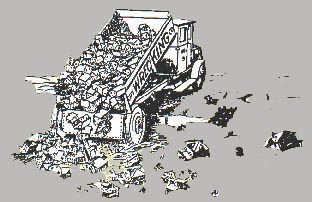
Owing to haphazard city growth hundreds
of perfectly good buildings go to the dump each year.
The validity of zoning was established in a landmark Supreme Court decision in 1926, Euclid v. Ambler Realty Co.,1 in which it was determined that the exclusionary nature of zoning was appropriate and in the public interest as a means to reduce nuisances, and as such overrides the interests of individual property owners. This case almost by itself guaranteed the validity of zoning as a rightful use of the state's police power, and led to its importance as the most significant tool of land use, and of planning, yet devised. And it was popular not because of its sophistication, but because of its simplicity.The Record on Zoning
Over the last 70 years zoning has had successes and failures. Charles Haar and Jerold Kayden summarized the many impacts of zoning with the following list:- Zoning helped establish the principle that the interests of private property owners must yield to the interests of the public.
- Zoning has delivered on its simpler promises such as keeping incompatible uses separated.
- Zoning has failed to deliver on its loftier promises of producing high-quality working and living environments.
- Innovative techniques such as incentive zoning have provided small-scale public amenities.
- Zoning has been misused by suburban communities to exclude low-income and minority families.
- Zoning engenders corruption, but so does all government exercise of power.
- Zoning has not dealt adequately with regiohal problems.
- Zoning can mandate only so much, and only in times of economic well-being.
(Charles M. Haar and Jerold S. Kayden. 1989. "Foreword: Zoning at Sixty--A Time for Anniversary Reckonings." from Haar and Kayden. Zoning and the American Dream. Chicago: Planners Press. pp. ix-xi.)

