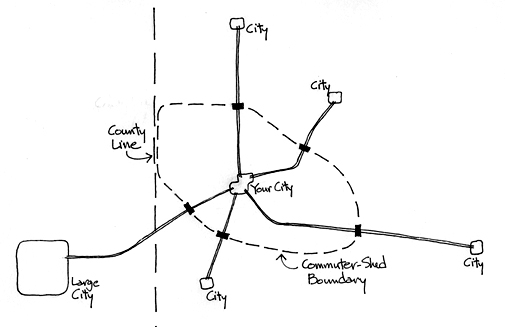
To analyze economic impact, a community's economic region should be defined. If no such boundaries currently exist, they can be derived by considering the following, beginning with the highest priority consideration:
1. What distance represents the general limits for employees to drive to work in your community? This is referred to as the "commuter-shed" (similar to the "watershed" for a river).
Techniques for determining commuter-shed:a. If you can, draw the commuter-shed boundaries based on information gathered from local employers.b. An alternative technique is simply to locate on commuter roads emanating from your community a spot midway between your city and the next larger city on that road. Connect these marks in a more-or-less circular pattern around your city to form its commuter-shed. (Note: If the next city along a road is much larger, the mark should be closer to your city, since the large city will generally draw from a further distance.)
2. After the commuter-shed boundaries have been drawn, they should be adjusted based on political or natural boundaries. In other words, if the commuter-shed boundaries are close to township or county boundaries, or significant rivers or other natural dividers, the boundaries should be adjusted accordingly.
3. Finally, and third priority, the boundaries may need to reflect the administrative boundaries of where data can readily be obtained. If it is very difficult to obtain population or economic data in an outlying area, for pragmatic reasons this area may be ignored as part of your community's Regional Economic Boundaries.
| Economic development | Economic development strategies |
|---|

